BOOKS BY JOE McGINNISS
 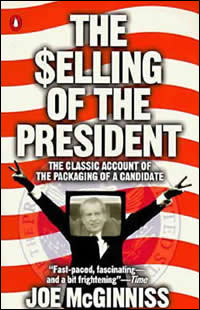    |
(1969) Joe McGinniss was a twenty-six-year-old Philadelphia newspaper columnist when he decided to write a book about the packaging of 1968 presidential candidate Richard Nixon by following his advertising and media people throughout the campaign. The result was a startling, riveting behind-the-scenes narrative of how a political candidate is packaged and sold to the American public. With its lively accounts of the clever and cynical men hired to sell Nixon (including the young and witty Roger Ailes) and its fresh insights into McLuhanesque campaign techniques, The Selling of the President broke the mold for campaign books. Published in 1969, it spent thirty-one weeks on the New York Times bestseller list. Still in print more than forty years later, it has become a classic of the genre, a staple in college courses, and a touchstone for anyone writing about the American political process even today. |
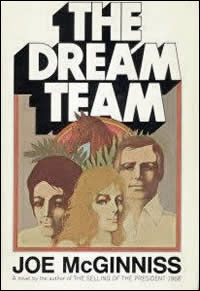 |
(1972) Joe McGinniss’s only novel takes readers on a heady, whirlwind trip to the once-glamorous Hialeah race course, and takes the narrator on a heady, whirlwind fling with a groupie that shows you can’t always get what you want, but if you break even in the end, maybe it’s okay.
|

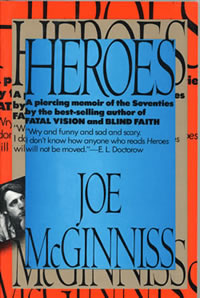 |
(1976) Heroes is the sad and searing, but often hilarious chronicle that McGinniss wrote to document his search for the vanished American hero. Containing intimate portraits of Gen. William Westmoreland, Daniel Berrigan, Ted Kennedy, William Styron, Arthur Miller, Eugene McCarthy, Howard Cosell, John Glenn and many others — and a self-portrait some regarded as too intimate — Heroes endures as a cult classic.
|
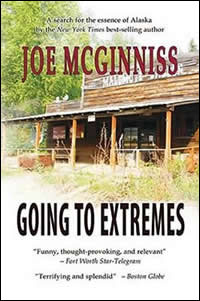 |
(1980) McGinniss headed north to see what was left of the Last Frontier. He discovered, as one reader put it, “mind-bending contradictions”: an ugly underbelly of greed, waste, addictions, and racism that contrasted with the state’s vast, wild natural beauty and its people’s open, independent spirit. Through a colorful series of encounters with bush pilots, boomers, park rangers, bartenders, teachers, journalists, waitresses, politicians, Natives, and a legion of Outsiders looking to get rich quick, McGinniss captures a unique place at a tumultuous time. Going to Extremes is a poignant, funny, and sometimes shocking portrait of a great land in the grip of irreversible changes, a time capsule of personal journalism even more valuable for readers today than it was when first published in 1980.
|
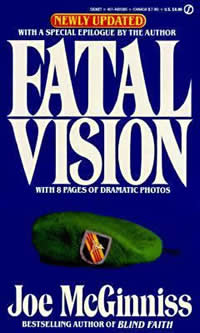 |
(1983) Fatal Vision tells the story of Dr. Jeffrey MacDonald, a charismatic, Princeton-educated Green Beret physician who one night in 1970 savagely murdered his pregnant wife and two small daughters. Initially set free by the Army, MacDonald was convicted ten years later, thanks to his father-in-law’s relentless pursuit. McGinniss, who lived with the MacDonald defense during the trial, chronicles every aspect of this horrifying and complex crime, including the dark psyche of MacDonald, a golden boy who on the surface seemed destined to live the American dream. Fatal Vision penetrates to the heart of one of the most notorious and controversial murder cases ever to capture the public’s attention. The book became a bestseller and has remained in print for decades. The NBC miniseries starred Karl Malden as the father-in-law and introduced Gary Cole with an impeccable portrayal of MacDonald. »Click here to read the 1989 Epilogue
|
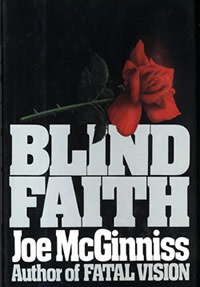 |
(1989) McGinniss took another look at a family riven by murder in this account of a Toms River, NJ, insurance man, Robert Marshall, who hired Mafia hitmen to kill his wife at a rest stop on the Garden State Parkway. McGinniss drew personally close to Marshall’s two older sons, who shared with him their double heartbreak: learning that their mother had been murdered, and discovering that their father had orchestrated the crime. Blind Faith reached number one on the New York Times best-seller list. The NBC miniseries starred Robert Ulrich and Joanna Kerns. |
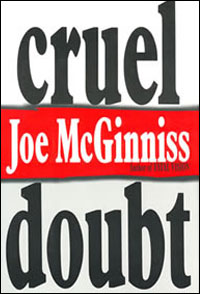 |
(1991) With Cruel Doubt, McGinniss completed his family-murder trilogy, unmatched in American letters. Bonnie Von Stein, a North Carolina mother and housewife, awoke in the middle of the night to find assailants beating and stabbing her as she lay in bed with her husband. Her husband died from injuries. Bonnie barely survived, only to find herself suspected of having planned the attack so she could inherit her husband’s fortune. In a twist even more cruel, she came to learn that her own son was involved, acting out a gruesome Dungeons & Dragons scenario. A New York Times best-seller. NBC miniseries starred Gwyneth Paltrow (in her first performance for television) and her mother, Blythe Danner. |
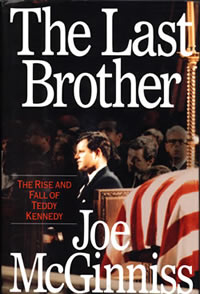 |
The Rise and Fall of Teddy Kennedy (1993) The Last Brother examined the life and inner turmoil of Sen. Edward M. Kennedy in the sixties, from the time his brother, John F. Kennedy, was assassinated, through his brother, Robert F. Kennedy’s assassination, and to the end of the decade, when the death of Mary Jo Kopechne at Chappaquiddick—found drowned in a car Teddy had been driving—assured that he’d never be able to fully follow in his brothers’ footsteps. Much maligned at the time by Kennedy supporters, The Last Brother survives as perhaps the most insightful and sympathetic look at Teddy Kennedy during the most eventful decade of his life and offers an unsparing look at the cynicism that went into the creation of the Kennedy myth. |
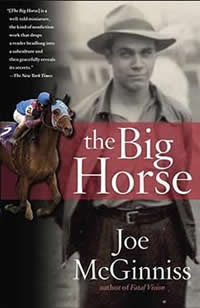 |
(2004) In 1971, Joe McGinniss planned to write a book about a summer season spent at Saratoga race course—the epitome of the Sport of Kings in America. His father’s illness and death prevented him from doing so, but more than thirty years later McGinniss returned to Saratoga to pick up the thread. There he met the marvelous P.G. Johnson, who for more than a generation had reigned as one of the leading horse trainers in the U.S. McGinniss soon found that Johnson’s earthy humor, flinty honesty and unflagging courage made the aging trainer a subject unlike any he’d found before: someone he could admire and root for without reservation. Like all true race track stories, The Big Horse ends sadly, but the voice of P.G. Johnson continues to ring loud and clear. |
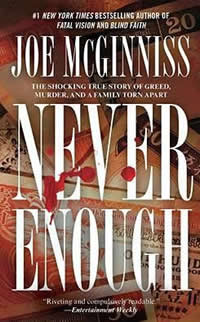 |
(2007) !n 2007 McGinniss returned to true crime with this disturbing tale of a family corroded by greed and brought to its knees by two tragic murders. The glamorous Kissels, Robert and Nancy, lived the American expatriate dream in a luxury condo high above Hong Kong’s glittering Victoria Harbor. They had three beautiful children and all the comforts money could buy. But that wasn’t enough. One terrible night, Nancy bludgeoned her husband to death. When arrested, she claimed Rob had abused her and forced her to do unspeakable sexual acts. Despite evidence that Nancy had been carrying on an affair with a blue-collar lover, she pled not guilty by reason of self-defense at trial. Less than two years later, as Nancy fought her conviction on appeal, the shattered Kissel family was dealt another blow. Rob’s younger brother Andrew, a real-estate tycoon facing federal embezzlement charges, was found stabbed to death in his Greenwich, Connecticut, mansion. McGinniss explores what dark impulses and wrong turns led these bright ambitious men to such dreadful ends. |
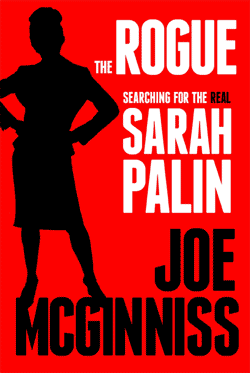 |
(2011) The Rogue: Searching for the Real Sarah Palin is a riveting chronicle of Sarah Palin as individual, politician, and cultural phenomenon. McGinniss’s on-the-ground reporting began in late 2008 and culminated in his living next door to Palin in Wasilla, Alaska, during the summer of 2010. The Rogue, a startling and penetrating examination of the illusion and reality of Sarah Palin, also presents an illuminating portrait of the Alaska and the America that produced her. Sometimes funny, sometimes frightening, always provocative, The Rogue answers the questions: “Who is she, really?“ and “How did she happen?” |
[…] her skewed perception of my relationship with Jeffrey MacDonald–the subject of my 1983 book, Fatal Vision–to support her bizarre hypothesis that “Every journalist…knows that what he does is morally […]
[…] “Going to Extremes” is the classic “pipeline era” book. It’s written by an outsider, but that’s sort of the point. Joe McGinniss describes the insanity of the multi-billion dollar pipeline project and the impact of new money and new people arriving in a tidal wave. It likely takes a number of detours from the exact truth, but you just have to take it all with a grain of salt. It asks a lot of questions about what defines the “Real Alaska.” It’s a question that residents of the state are constantly negotiating. […]
[…] has written 12 books in all, mostly well-known for their political-related […]
[…] has written 12 books in all, mostly well-known for their political-related […]